The legal industry has always prided itself on expertise—depth of knowledge, the sharpness of argument, the quality of counsel. But in 2026, expertise alone is no longer enough.
Today’s clients are measuring your firm against every service experience they’ve ever had: the bank app that shows their balance in real time, the healthcare portal that sends appointment reminders automatically, the contractor who texts a project update without being asked.
This has led to an interesting challenge: client expectations have accelerated far faster than most firms’ operational evolution. The result is a widening gap—one that shows up in the friction clients feel when they can’t get a timely update, can’t figure out their invoice, or struggle to remember what they were supposed to sign and send back three weeks ago.
Closing that gap is one of the most important competitive opportunities your firm has right now. Here’s what clients actually expect in 2026—and where most firms are still struggling to catch up.

What Clients Expect in 2026
1. Fast, Consistent Communication
Speed has become the primary driver of client satisfaction in professional services. A recent survey by Lead Response Management found that responding to a new lead within 5 minutes increases the chance of connecting with a client by four times compared to a 10-minute delay. This discrepancy is less about the attention paid to a client’s feelings and more about operational gaps that feed a perception of indifference.
The same research noted that clients now expect greater transparency, faster turnaround times, and more flexible pricing models across the board.
So, what does this mean in practice? For starters, clients who don’t hear from you assume nothing is happening. Silence breeds anxiety, and anxiety breeds complaints, chargebacks, and lost referrals.
2. Digital-First Convenience
If your onboarding process still involves printing forms, scanning documents, or exchanging information through unthreaded email chains, you’re already behind. Clients—particularly younger clients—expect to complete intake online, sign documents electronically, use secure messaging, receive updates digitally, and pay invoices from their phone.
3. Transparent, Predictable Billing
Few things erode trust faster than a confusing invoice. Clients want to understand what they’re being billed for, and they want that clarity before a charge appears—not after they’ve already received a statement that requires a follow-up call.
Upfront cost conversations, consistent billing formats across matters, and online payment options are the foundation of a billing experience that clients trust.
4. Real-Time Visibility into Their Matter
Consumers have been conditioned by retail, banking, and logistics to expect status updates without having to ask. Your client with a pending litigation matter or a closing transaction doesn’t want to call your office to find out what’s happening—they want to see for themselves.
When clients can’t get that visibility, they fill the void with worry. And worried clients call more, email more, and require more hand-holding—all of which consumes non-billable hours your team could spend elsewhere.
5. An Organized, Informative Onboarding Experience
The first weeks of a client relationship set the tone for everything that follows. A disorganized intake process signals that the rest of the engagement will feel similarly chaotic.
Confusing or slow onboarding remains a leading reason why prospective clients fail to convert.
Where Law Firms Are Still Catching Up
Understanding the expectation gap is one thing. Seeing it clearly in your own operations is another.
- Response times are inconsistent. Even firms with excellent attorneys often struggle to maintain communication SLAs across all clients and matters. When response time depends on individual attorney habits rather than firm-wide systems, clients receive wildly different experiences depending on who’s handling their matter.
- Intake is still manual for most firms. According to ABA data, fewer than 30% of firms offer fully digital intake—despite overwhelming client demand for it. That means the majority of firms are still collecting information through paper forms, email attachments, and manual re-entry into their systems. Every redundant step is a friction point.
- Billing clarity remains a persistent challenge. When invoice formats vary from matter to matter, or when billing descriptions are too vague to be meaningful, clients lose confidence in the process. The follow-up explanations waste time on both sides and create a perception of inefficiency that clients will remember—and mention to others.
- Limited visibility into matter status drives unnecessary contact. When clients can’t check in on their matter independently, they call, email, or ask their attorney’s assistant. Without client portals, updates depend on manual checks and individual follow-through—a system that breaks down under volume and creates inconsistency.
- Hybrid teams struggle to maintain consistent client service. Today’s firms often have attorneys working across offices and remotely. Without a unified system for communication, clients in the same firm can receive dramatically different experiences depending on which team member they most recently spoke with.
How to Assess Opportunities to Improve Your Client Experience
Before investing in any operational change, it helps to get an honest read on where the gaps actually are. Here’s a simple diagnostic framework:
Step 1: Examine your communication workflows. Is client communication stored in one centralized place, or scattered across individual email inboxes? How long do clients typically wait for a response? Mobile apps and e-signature capabilities are small improvements that add up over time to enhance your client experience.
Step 2: Review your intake process. Are clients completing paperwork manually? Is your team re-entering information that clients already provided in a different format? Switching to automated Intake forms can streamline your intake process and reduce redundant administrative tasks.
Step 3: Evaluate your billing clarity. How often do clients call or email with billing questions after receiving an invoice? If the answer is “regularly,” your billing process is working against you.
Step 4: Identify where clients wait for updates. Map a typical matter from intake to close and mark every point where a client is waiting without knowing what’s happening.
Step 5: Consider scalability. Can your firm absorb a substantial increase in new clients without slowing down service quality? If not, your operational infrastructure is already limiting your growth.
What a Great Client Experience Actually Looks Like
A great client experience isn’t complicated to describe: clarity, predictability, and regular updates delivered through a process that clients can navigate without confusion. The difficulty is in building operational systems consistent enough to deliver that experience at scale, across every matter, every client, and every team member.
Jen Lee, founder of Jen Lee Law & Lawyer Success Network, built exactly that kind of experience for her bankruptcy clients—and the results illustrate what’s possible when workflows are redesigned around the client rather than around internal convenience.
Before the change, collecting required documentation from clients could take two to six months. Clients weren’t sure what was needed, when it was needed, or how to return it efficiently. The firm was spending enormous amounts of time on administrative follow-up that added no legal value.
By redesigning her workflows around a client-facing portal, Jen was able to give clients clear, stage-by-stage guidance on exactly what to submit and when. Instead of months of back-and-forth, clients now complete their required tasks in two to three weeks. The firm saves more than 10 non-billable hours per month previously spent on administrative follow-up.
The operational change had a human impact as well. Clients going through bankruptcy are under significant stress. The predictability and clarity of the new process reduced their anxiety, made progress visible and understandable, and gave them a sense of agency in a situation where they’d otherwise feel out of control.
As Jen describes it, the shift wasn’t simply about saving hours—it was about transforming how clients feel through a difficult legal process.
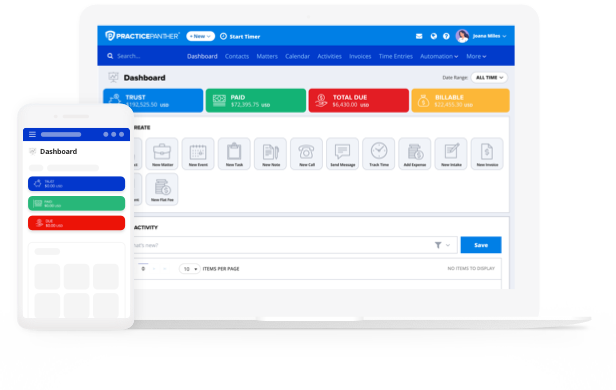
That transformation is available to any firm willing to take a hard look at where friction exists and build systems that eliminate it. PracticePanther supports exactly that kind of operational redesign: centralizing matter communication so nothing gets lost across inboxes, streamlining intake to reduce friction from the very first interaction, integrating billing and online payment to improve clarity and convenience, providing real-time dashboards that give clients and attorneys alike better visibility across matters, and automating reminders and updates so clients feel supported between attorney interactions. For hybrid teams, reliable access to a unified system ensures consistent service quality regardless of where team members are working.
Adapting to Evolving Expectations
The expectation gap in legal services is real, and it’s widening. Clients who experience friction don’t always complain directly. More often, they simply don’t refer or return.
The firms that adapt to where client expectations are in 2026 will retain more clients, generate more referrals, and build reputations that attract better matters. The firms that don’t will find themselves competing on price for clients who don’t feel they have reason to stay loyal.
The question worth sitting with isn’t whether your firm delivers great legal work. It almost certainly does. The question is whether the experience of working with your firm matches the quality of that work.
If you’re ready to close that gap, explore how PracticePanther can help your firm strengthen communication, simplify operations, and deliver the client experience that 2026 demands. Start a free trial today.