Many law firms believe they understand their financial performance because they know their monthly revenue. But determining true profitability means asking and answering questions that lie outside of revenue data. Questions like:
- Which matters consume disproportionate time and resources?
- Which clients are struggling to pay?
- Which processes drive margin versus operational burden?
A high-producing attorney may look successful on paper and simultaneously underperform in realization or collections. Practice areas that appear lucrative may actually yield lower margins once operational costs are factored in.
To stay competitive, law firms should reframe profitability as an ongoing operational discipline rather than a quarterly or annual exercise. Read on to learn which metrics define profitability, and how six simple financial reports fuel growth-minded planning.
Prioritizing Only Top-Line Growth Only Gets You So Far
It’s easy to celebrate the wins: record billables, increased matter volume, growing collections, and more new client intake. These are real indicators of success, but they don’t tell you whether your firm is actually becoming more profitable in the grand scheme of things.
Behind strong revenue numbers, a different story can be quietly unfolding:
- High write-offs and discounts eroding realized income
- Underpriced work that looked reasonable at intake
- Excess partner involvement in matters that don’t justify the rate
- Long payment cycles tying up cash flow
- Administrative overhead consuming attorney capacity that should be billable
Consider two firms with identical annual revenue.
One runs lean, bills accurately, collects efficiently, and staffs matters with precision. The other incurs high overhead, frequently discounts, and struggles with collections. Their P&Ls, and cashflow statements look nothing alike—despite the same topline number.
What Matter-Level Profitability Looks Like
Assessing profitability at the matter level requires connecting several data points that are often managed separately:
- Time worked
- Expenses incurred
- Billing completed
- Payments collected
- Staff involvement
- Any write-downs or discounts applied along the way
When you bring all of this together for a single matter, you may find hidden conflicts. For example, discovering that a client whose invoices get paid quickly is technically more profitable than a client with the highest billed amount.
Really, this is the shift from reactive management to operational leadership—using data not to explain what happened, but to shape what happens next.
Assess True Case Profitability: See how to measure margin at the matter level and make smarter staffing and pricing decisions in PracticePanther. Watch the webinar

The Reports That Fuel Growth Decision-Making
Consistent financial visibility identifies growth bottlenecks early, reduces revenue leakage, identifies inefficient cost structures, and helps leadership allocate marketing spend toward the work that actually drives profit.
Using these five reports from PracticePanther, firms can monitor a core set of financial data and use the findings to make data-informed decisions.
- Originating Attorney Report: This tells you who brings in the highest-value business—not just the highest volume of clients. Understanding where profitable work actually comes from helps you allocate business development resources more effectively and identify which relationships deserve the most attention.
- Productivity Report: This report surfaces where attorney capacity is being consumed by administrative work, internal meetings, or tasks that could be delegated—and gives leadership a clear picture of where efficiency gaps exist.
- Realization Report: Your realization rate measures how much of your worked and billed time actually converts into cash. Write-offs, discounts, and billing adjustments all reduce realization—and firms that don’t track this closely often underestimate how much they’re leaving on the table.
- Accounts Receivable Aging: Cash flow bottlenecks rarely appear out of nowhere. An AR aging report identifies which invoices are overdue, which clients have patterns of slow payment, and where your collection process may need attention—before those delays become revenue problems.
- Matter Profitability Report: This is where firm-wide analysis becomes actionable. A matter profitability report compares revenue generated against the time invested and expenses incurred on a specific case. Matters that look successful based on billed amounts may underperform significantly once full resource allocation is included.
The Financial Reports Every Law Firm Should Be Using Learn how to put each of these reports to work in your firm—and what to do with what you find. Watch the webinar
How PracticePanther Helps Firms Gain Real Financial Visibility
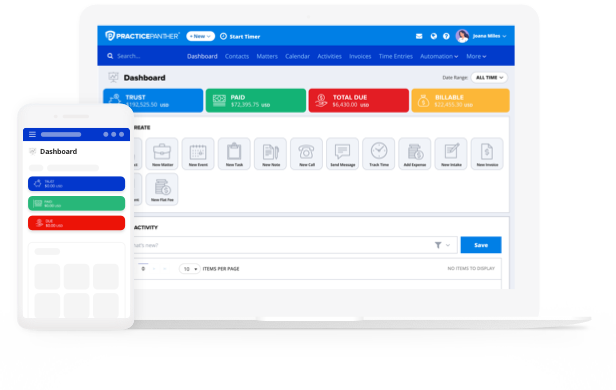
PracticePanther is built to connect the data points that law firms most commonly manage in isolation: time tracking, billing, payments, matter data, financial reporting, and accounting workflows—all within a single platform.
That means custom reporting by attorney, matter, or client. Real-time realization and revenue tracking. Collections and aging visibility without manual reconciliation. Matter-level profitability insights that connect billables to actual outcomes. And built-in accounting workflows through PantherAccounting Plus that eliminate the spreadsheet-driven reconciliation that slows so many firms down.
The question worth asking is whether your current system actively helps you make better decisions.
If your firm is ready to replace financial guesswork with real visibility, explore PracticePanther’s reporting webinars and see how stronger reporting habits can drive smarter, more sustainable growth.