

Law firms often generate a significant amount of financial data through the normal course of business, from billable hours and collections to expenses and matter performance. The challenge is often turning all of that information into a clear, timely view of what’s driving profitability and where the firm may need to adjust.
Without the right systems in place, law firm leaders may rely on outdated historical trends or even hunches to inform important financial decisions that should instead be grounded in organized, accessible data. While gut instinct has gotten a lot of firms this far, it’s no longer enough to keep them ahead of the competitors setting the pace by prioritizing data analysis to drive operations, assign work, price matters, and measure who’s actually bringing in revenue.
That kind of real-time financial visibility is becoming a real competitive edge, and it’s actually easier to implement than most partners think.

What Financial Visibility Actually Means
True financial visibility is how readily a firm’s leaders can answer a handful of fundamental questions on any given day, not just the week after the books close:
- What have we billed?
- What have we collected?
- Where is our revenue actually coming from?
- Which invoices are still outstanding, and for how long?
Most firms can eventually produce those answers, but the real difficulty lies in how much effort it takes to do so. They’re exporting data from different systems, rebuilding spreadsheets, and reconciling figures by hand. By the time the full picture is assembled, the numbers are already weeks out of date.
Timely answers depend on having connected data. Real visibility shows up when your time tracking, billing, and payment data already live in a single platform. Where the numbers are current the moment leadership looks at them, rather than something the team has to reconstruct.
What follows is how PracticePanther makes it easy to answer each of those four questions through real-time financial reporting, giving firm leaders a clearer basis for making the strategic decisions that shape the practice and keep them a step ahead of the competition.
Turn Financial Visibility into Action with PracticePanther
See Where All Case Work Billing Stands
Two simple, yet foundational questions determine how a firm’s financials turn out any given month: what have we billed for, and what was actually collected? The gap between the two numbers is where revenue disappears, and leaks tend to result from no one seeing the gap clearly enough to act on it.
Studies have shown that attorneys spend less than 2.5 hours of an 8-hour day on billable work, with non-billable tasks, such as administrative duties and general firm management, absorbing the rest. Even the time that does get captured doesn’t fully convert into revenue, with industry realization rates averaging around 80%. Meaning close to 20% of billable work never reaches an invoice.
Each of these shortfalls is recoverable, but only if leadership can see it fast enough. However, those gaps don’t surface right away when worked time, billed time, and collections live in disconnected systems. Time slipping into administrative work or a soft realization rate doesn’t stand out when numbers need to be stitched together, and productivity ends up becoming an estimate.
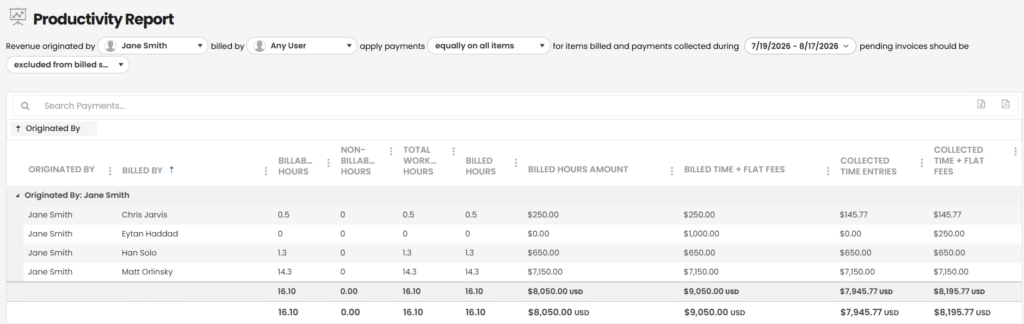
PracticePanther’s Productivity Report brings those numbers into one view. Leaders can filter by team member over any time frame to see task completion, billable vs. non-billable time, and collection rates side by side. Making the inefficiencies eating into profitability visible enough to actually fix.
How firms use this report:
- Compare billed and collected totals by attorney to see who converts work into revenue
- Identify when too much time is going to administrative work instead of client matters
- Reallocate matters and staffing based on actual production
The result is a clear view of who’s carrying the firm’s workload, what’s been billed, what’s been collected, and where to make adjustments or add support before the imbalance shows up in the bottom line.
See Who’s Driving Profitable Business
Every firm has a sense of who its rainmakers are, but fewer firms can say with 100% certainty which of those relationships actually drive revenue and which mainly generate activity. An attorney handling a high volume of matters can appear to be a leading contributor, while the revenue those matters generate tells a more modest story, and another attorney with a few well-chosen clients can be doing far more for the firm financially.
That distinction matters because business development budgets, marketing focus, partner compensation, and decisions about which practice areas to grow all depend on knowing exactly where profitable work originates. When that lens is missing, those resources tend to follow the volume, since volume is the part that’s easy to see, even when the value sits somewhere else.
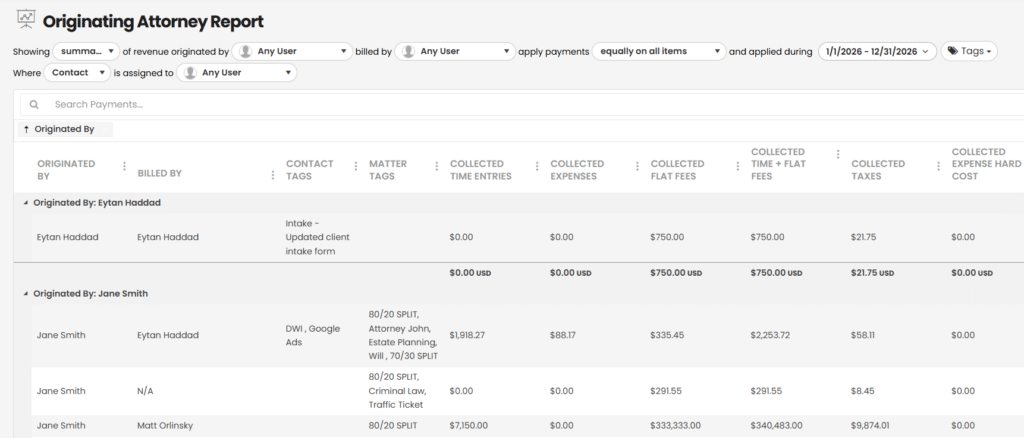
PracticePanther’s Originating Attorney Report attributes new business and revenue back to the team member who brought it in. Because it’s built on collected dollars rather than matter counts, it shows the value each relationship actually brings in, rather than only the volume of activity around it. Leadership can see each originator’s total collected time entries, flat fees, expenses, and more, filtered by an individual or across the whole team. Then custom tags make it possible to build accurate commission and cost-split reports.
How firms use this report:
- See which attorneys originate the highest revenue business, so profitable relationships are easy to tell apart from high-volume ones
- Build accurate commission and cost-split reports with custom tags
- Direct business-development time and spend toward the relationships that pay off
Once those contributions are visible, the firm can act on them in both directions. Leaders can study what the top originators do well and work to replicate it across the practice, while fairly compensating the people responsible for the firm’s most valuable business.
See Where Cash Flow is Grinding to a Halt
Cash flow problems don’t just show up overnight; they accumulate quietly, one aging invoice at a time, until a firm that looks profitable on paper finds itself short on the cash required to operate effectively. The gap between earning revenue and actually collecting is where otherwise healthy firms can get into trouble.
Collection risk compounds over time. A receivable is most collectible the moment it’s issued, and its value erodes the longer it sits. In fact, once a balance is 90 days past due, the probability of collecting it falls to roughly 69.9%, compared to 89.9% when it’s resolved within 30 days.
Slow payment also tends to be a pattern rather than a one-off. Certain clients pay late consistently, and without a clear view of who they are, a firm might keep extending informal credit to the accounts least likely to pay on time.
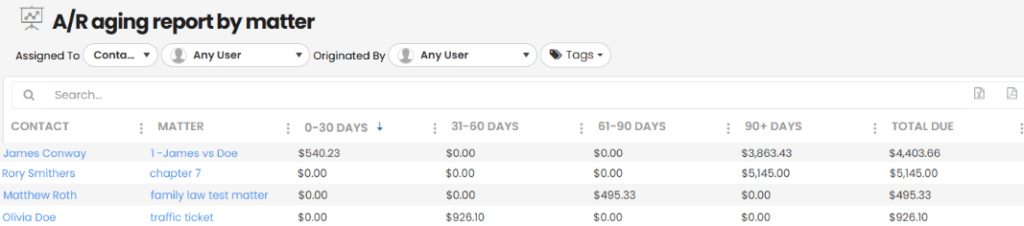
PracticePanther’s Accounts Receivable Aging Report tracks overdue invoices by client or matter and breaks every balance into clear categories: 0-30, 31-60, 61-90, and 90-plus days past due. Instead of a single lump sum of “money owed”, leadership sees exactly how much is current, how much is drifting, and how much has aged into real risk. And because every balance is tied to a specific client and matter, the chronic slow-payers no longer hide in the aggregate.
How firms use this report:
- Sort outstanding invoices by age to prioritize collection efforts when they matter most
- Flag clients with a pattern of slow payment before it reaches cash flow
- Implement proactive follow-up strategies to recover overdue balances, such as automated reminders or applying interest to aged invoices
The real advantage here is timing. Being able to see outstanding invoices organized by age gives the firm a window to follow up while the balance is still collectible and to hold onto revenue it has already earned. Moving collections from reactive cleanup to a routine, proactive process.
Build One Connected View Into Your Firm’s Financial Health
These reports are most effective when you stop reading them one at a time. Production, origination, and receivables are three angles to answering “is the firm as healthy as it looks?”
The firms pulling ahead treat real-time financial visibility as a daily habit, which enables them to make faster, sharper calls on pricing, staffing, and where to focus collections. Compounding into a genuine edge over competitors still assembling the same picture, weeks later, from one disconnected source at a time.
With PracticePanther, the financial data firms need can be generated, customized, and saved instantly in one place, so you can answer those key financial questions the moment you need to. If you’re ready to see how these reports can help your firm gain clearer financial visibility, feel free to schedule a demo with us today!