Running a successful firm requires more than just a law degree, especially for smaller firms with heavy caseloads. One of the biggest challenges these firms face is the administrative burden of day-to-day operations.
When you struggle to manage these administrative tasks efficiently, the consequences can be serious, including reduced productivity, revenue leakage, strained client relationships, impeded growth, and compliance issues.
And the challenges compound as case volume increases and scattered case and client information slows everything down. Time-consuming and error-prone manual processes do small, high-volume firms no favors.
The solution is a simple one: an improved framework for legal matter management, one that trades outdated, ineffective manual processes for a streamlined, centralized system that makes key information easily accessible, reliable, and accurate.
In addition to streamlining your case management framework, legal case management software can help ensure no details fall through the cracks.
What Is Legal Matter Management?
Legal matter management is the structured process of organizing, tracking, and overseeing legal cases from initial client intake through resolution. It’s more than just document tracking, though, as it also relates to budgets, deadlines, assigned staff, communications, court filings, and outcomes.
An effective legal matter management system coordinates each of these aspects, simplifying workflows and creating a single, accessible source of truth. By applying a repeatable, systematic legal matter management framework, your firm can be more proactive and less reactive.
This approach often requires adopting an electronic legal matter management system (or legal matter management software) that simplifies workflows, centralizes data, manages document templates, tracks deadlines, and even automates routine tasks like new client onboarding, payment processing, and invoice management.

Why Is Legal Matter Management Important?
While firms of all types and sizes benefit from improved legal matter management, it’s especially important for small and mid-sized firms. It shouldn’t be difficult to imagine why an attorney who spends the day focused on cases can find it challenging to return client calls, prepare and review documents, and send invoices in a timely manner.
Without an effective, unified framework for managing each aspect of matter management, mistakes are bound to be made. Attorneys are only human, after all, and there are only so many hours in their days.
Structured legal matter management solutions minimize many of the risks, while providing additional benefits that improve organization and communication, reduce costs, and ensure that no communication goes unanswered. For solo practitioners and small teams, a legal matter management system can be the difference between being proactive and organized and being reactive and scrambling.
Benefits of Legal Matter Management Systems
A comprehensive legal matter management system provides several compelling benefits for firms looking to improve client relationships, increase efficiency, and simplify operations. These include:
- Centralized Information: These platforms collect and organize all documents, contacts, billing data, and case data in a single, accessible location.
- Streamlined Workflows: Standardized processes, workflows, and templates reduce the administrative burden, freeing up staff to work on client-facing or revenue-generating activities instead.
- Improved Collaboration: Firm-wide legal matter management systems make it easier for all team members to stay aligned on processes and deadlines, reducing miscommunication and errors.
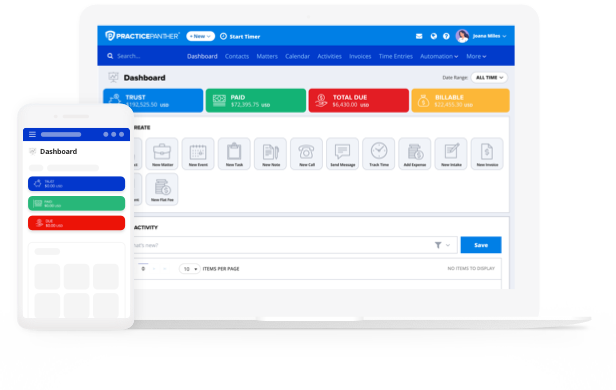
- Better Visibility: Implementing a legal matter management system improves firm-wide visibility through dashboards and tracking features. These provide a real-time view into how matters are progressing, as well as upcoming deadlines.
- Risk Mitigation and Compliance: By keeping tasks and documents well-organized, these systems reduce firms’ exposure and support their compliance with state rules governing professional conduct.
PracticePanther takes these benefits further through built-in automation that handles the repetitive, time-consuming tasks that pull attorneys away from billable work, like client onboarding, invoice generation, and deadline reminders. Before exploring how, it’s worth exploring the full scope of what structured matter management looks like in practice.

Key Takeaways for Legal Matter Lifecycle Management
Before getting into the components of a well-structured matter (essential for effective legal matter management), a few core principles are worth reinforcing:
- Streamlined legal matter management systems transform disorder into order. By centralizing all case details into a single, unified repository, these systems make the right information and insights available when they’re needed most.
- The right platform saves time, reduces stress, and enables your firm to grow. Not all legal matter management companies provide the same features, though, making careful evaluation important. PracticePanther, for example, offers advanced features like automation of repetitive tasks, as well as document creation tools, deadline management, invoice processing, and more.
- With the right framework in place, small firms can scale caseloads without compromising client relationships or case outcomes. And a legal matter management solution like PracticePanther supports a firm’s growth through task and workflow automation, faster billing, customized client portals, and cloud-based document management.
While every legal matter is unique and should be treated as such, a complete and well-rounded matter management framework ensures a consistent, client-first approach to each matter.
The sections below outline each component of a complete matter lifecycle; it can serve as a framework you can adapt into a working template for your firm. These practical legal matter management examples show how structure and consistency translate into better outcomes.
As you read through, consider the difference between managing these items manually and letting a legal matter management platform like PracticePanther take on the administrative burden.
1. Matter Overview
Every matter starts with the same basic information: client name, matter type, assigned attorney, jurisdiction, case number, and current status. While it’s not impossible to capture these details manually, a platform that automatically captures this information and makes it visible across your dashboard can save a great deal of time and minimize the chance of errors.
Components can include:
- Matter Name
- Matter Type (e.g., Immigration / H-1B, Family Law / Divorce, Personal Injury / MVA, Criminal Defense / Misdemeanor)
- Date Opened
- Client Name(s)
- Primary Attorney
- Supporting Staff / Paralegals
- Opposing Counsel
- Jurisdiction / Court
- Case Number (if assigned)
- Matter Status: (Open / Pending Info / In Discovery / Negotiation / Awaiting Hearing / Closed)
2. Core Objectives & Scope
Once the basics have been captured, details like the scope of work, expected timeline, and key risks help to keep everyone aligned and working toward the same outcomes. Defining these items as close to the outset of the matter as possible makes it easier to stay focused in the face of shifting priorities, or when new complications arise.
Components can include:
- Key Objectives
- Defined Scope of Work
- Expected Duration
- Key Risks / Constraints
3. Intake & Required Information Checklist
A reliable intake process ensures that no detail gets missed. Your intake checklist should account for everything from conflict checks, signed fee agreements, and retainer payments to matter-specific documents such as medical records, prior filings, or contracts.
The right legal matter management software enables firms to standardize their intake checklists and automatically track them throughout the matter.
Components can include:
Client Information
- ID & Contact Information
- Fee Agreement Signed
- Conflict Check Cleared
- Retainer Paid (If Applicable)
- Supporting Documents Submitted
Matter-Specific Documents
- Prior Filings
- Contracts
- Police Report
- Medical Records
- Employment Documents
- Evidence & Exhibits
- Timeline of Events
4. Deadlines & Compliance
Court deadlines, filing windows, statutes of limitations, and internal milestones should all be organized by owner and status. Missing a single deadline can have a big impact on client relationships and matter outcomes.
Using legal matter management software is the best way to keep every deadline visible. It can also be configured to send proactive, customized reminders before a routine deadline becomes an emergency.
Components can include:
- Court Deadlines
- Filing Deadlines
- Statute of Limitations
- Internal Milestones
- Client Follow-Up
5. Task & Workflow Tracker
From onboarding a client through post-close follow-up, each matter stage involves specific tasks that need to be assigned, prioritized, and tracked. Creating an organized system for collecting, organizing, and making this information readily available can have a huge impact on productivity, relationships, and results.
Components can include:
- Intake
- Initial Review
- Discovery / Evidence Gathering
- Strategy & Preparation
- Filing / Motions
- Hearings / Settlement Discussions
- Resolution & Closing
- Post-Matter Follow-Up
6. Budget & Financials
Financially-healthy firms don’t get that way by accident. Instead, these firms know the importance of accurately tracking estimated versus actual costs (e.g., filing fees, expert witnesses, research vendors) alongside billing structure and retainer status.
When this tracking is done with efficiency (through automation, for example), it brings order to what can be one of the most organization-resistant aspects of running a successful firm.
Components can include:
- Filing Fees
- Expert Witnesses
- Travel
- Research / Vendors
- Retainer
- Billing Structure (Hourly / Flat Fee / Contingency / Hybrid)
- Payment Status (Up to Date / Past Due / Needs Review)
7. Communication Log
Every call, email, and meeting should be logged, along with a summary and next steps. In addition to simply being a best practice, it also serves to protect the firm if a dispute or misunderstanding occurs over the course of working with a client.
When you have complete, organized communication records, there is much less room for ambiguity or argument. PracticePanther makes it possible to create customized client portals to provide transparent access to relevant communications, online payments, and more.
Components can include:
- Communication Date
- Type (Call / Email / Meeting)
- Participants
- Summary
- Next Step(s)
8. Document Log
The average matter generates a number of vital documents, including pleadings, discovery files, contracts, client correspondence, and billing records.
Modern firms use legal matter management software to keep track of all documents related to individual matters, including version control (i.e., who uploaded what, and when) to prevent the confusion that can happen when working with outdated or inaccurate files.
Components can include:
- Document Name
- Document Type
- Uploaded By
- Date Added
- Version
- Additional Notes
9. Case Strategy Snapshot
To ensure everyone is on the same page, the primary legal strategy, key arguments, known weaknesses, and contingency approaches should be documented and accessible to everyone on the matter, rather than having this information live with different teams in separate silos.
Using legal matter management software makes this much easier than tracking case strategy details through spreadsheets, email inboxes, or unstructured updates.
Components can include:
- Primary Legal Strategy
- Key Arguments
- Potential Weaknesses
- Backup / Alternative Strategies
10. Matter Status Summary (At-a-Glance)
Keeping the whole team aligned with a real-time view of matter progress, upcoming deadlines, outstanding tasks, and immediate priorities helps a firm to operate smoothly and effectively, even for smaller firms with large or increasing caseloads.
PracticePanther’s platform provides the kind of accessible, high-level visibility into each matter’s current stage, progress, and key metrics that are essential in understanding a matter and where it stands without having to review every individual communication, document, or update.
Components can include:
- Overall Progress (Not Started / In Progress / At Risk / Completed)
- Upcoming Deadlines
- Outstanding Tasks
- Immediate Priorities
11. Closing & Post-Matter Review
Effective client retention is essential for any firm that’s looking to grow in either the short- or long-term future. Even firms that provide a responsive client experience and deliver positive outcomes don’t guarantee repeat business, however.
Client retention isn’t easy, even for the best attorneys. Every client expects positive results, but they also expect personalized service and to get what they perceive to be their money’s worth in terms of insights, strategy, and follow-through.
Your ability to close the loop with clients in a way that leaves a positive impression can be the difference between retention and attrition. To improve retention, consider starting simply with client satisfaction follow-ups.
When appropriate, you can request referrals from your most-satisfied clients in order to grow your firm through one of the most efficient means possible: word-of-mouth success stories.
Components can include:
- Outcome
- Date Closed
- Final Billing Completed (Yes / No)
- Client Satisfaction Check
- Follow-Up Sent? (Yes / No)
- Testimonial Requested? (Yes / No)
- Referral Asked? (If Applicable; Yes / No)
- Internal Debrief
- What Worked Well?
- Where Delays Occurred?
- What Should be Standardized in the Future?
Together, these components form the foundation of a well-run practice, one where nothing gets missed, no deadline goes untracked, and every client interaction is accounted for.
Putting It All Into Practice
Now that you understand the components of effective legal matter management, you should be thinking about how to put them into practice. But it can be overwhelming to track and manage each aspect of legal matter management manually, which is why the right platform can make a big difference by reducing the administrative burden and preventing revenue leakage, among other benefits.
PracticePanther’s platform was built to ensure no more missed deadlines or underserved clients. From intake checklists and deadline tracking to automated billing, document management, and client portals, it brings every component of the matter lifecycle into a single, unified platform.
To see the platform in action, schedule a demo or sign up for a free trial.