In every growing law firm, there comes a moment when the workload doesn’t just feel heavy—it feels tangled.
Staff spend more time chasing information than advancing matters. And leadership can’t quite pinpoint where things are slowing down.
These aren’t performance problems. They’re legal case management bottlenecks.
Bottlenecks don’t appear because teams lack talent or dedication. They emerge when processes, systems, and visibility can’t keep pace with firm growth. When left unaddressed, they quietly erode profitability, client experience, and morale.
Here are the six most common case management bottlenecks law firms face and practical ways to eliminate them before they constrain your growth.
1. Intake Delays That Create Downstream Chaos
The Bottleneck
Effective case management starts before the case even begins. But many firms treat intake as an administrative step rather than a strategic one. When intake is inconsistent or fragmented, subsequent matters inherit those flaws.
The most common intake bottlenecks include:
- Incomplete client information
- Siloed data entry across multiple systems
- Delayed conflict checks
- Lack of standardized matter setup
- Slow follow-up on prospective clients
When intake stalls, cases start with missing data, unclear expectations, and avoidable rework. That slows everything: calendaring, billing, document preparation, and communication.
The Cost
- Lost revenue from unconverted leads
- Staff time spent correcting incomplete records
- Poor first impressions with clients
- Increased risk of missed deadlines
According to the ABA, only 40% of U.S. law firms answer incoming calls from prospective clients, leaving 60% of potential new-client calls unanswered and resulting in significant missed revenue opportunities. Ultimately, a chaotic intake process compounds inefficiencies throughout the case lifecycle.
The Solution
High-performing firms standardize and automate intake wherever possible:
- Use structured intake forms that capture required data consistently
- Automate conflict checks and matter creation
- Assign clear ownership of intake stages
- Centralize all intake data in one system from day one
With PracticePanther, firms can capture client information through custom intake forms, automatically generate new matters, and immediately assign automated workflows and tasks. That means cases begin with complete, organized data—not guesswork.
2. Scattered Information Across Emails, Spreadsheets, and Drives
The Bottleneck
The fact of the matter is, every minute spent hunting for information is a minute not billed or spent serving clients. If your team has to ask, “Where is that file?” more than once a week, you have an information bottleneck.
The core issue? Many firms operate across disconnected systems:
- Email for communication
- Shared drives for documents
- Spreadsheets for tracking
- Calendar apps for deadlines
- Separate billing platforms
The result? Information silos. When case details are stored in multiple locations, attorneys and staff waste valuable time searching, reconciling versions, and verifying accuracy. Worse, critical information often slips through the cracks.
The Cost
- Hours lost each week searching for documents
- Duplicate work and version confusion
- Increased malpractice risk
- Frustrated staff and delayed client responses
A IDC white paper found that information workers, including lawyers, spend about 11.2 hours per week on document creation and management, with up to 6 hours per week wasted on document retrieval and related tasks.
The Solution
The solution is centralization.
All case-related data—communications, documents, tasks, billing, notes — should live in one unified environment tied directly to the matter.
PracticePanther centralizes:
- Email communications within the matter
- Document storage and version tracking
- Task assignments and deadlines
- Time tracking and billing records
When everything is connected to the case file, context is immediately revealed. Instead of assembling information from five sources, your team opens one matter and sees the full picture.

3. Manual Task Management That Breaks at Scale
The Bottleneck
In smaller firms, task tracking often starts informally:
- Sticky notes
- Verbal reminders
- Shared spreadsheets
- Individual to-do lists
But as caseload grows, informal tracking collapses.
Without standardized workflows:
- Deadlines get missed
- Tasks get duplicated
- Work isn’t evenly distributed
- Partners lack visibility into progress
The Cost
- Missed court dates
- Uneven workloads and burnout
- Reactive fire drills
- Lack of accountability
What works for 20 open matters fails at 120. Inconsistent and outdated practices—such as manual spreadsheets, disconnected invoicing systems, and unintegrated budgets—are a significant driver of revenue leakage in legal finance operations. One white paper found that 40-60% of law firm write-offs are due tooverall process breakdowns.
The Solution
The core issue is that manual task management doesn’t scale, but structured workflows do. Firms should build repeatable workflows for common case types. Every new matter should automatically trigger predefined tasks with assigned owners and due dates.
For example:
- Personal injury intake triggers medical record requests
- Estate planning triggers document drafting milestones
- Litigation triggers discovery and filing deadlines
PracticePanther enables firms to create automated workflows that attach to new matters instantly. Tasks populate automatically, ensuring consistency and eliminating reliance on memory.
4. Poor Visibility Into Case Status and Workload
The Bottleneck
Ask three team members the status of the same case, and you may get three different answers.
Without real-time visibility:
- Partners struggle to forecast revenue
- Managers can’t identify stalled matters
- Associates don’t know which cases need priority
- Staff feel reactive instead of strategic
A lack of visibility isn’t just inconvenient; it creates operational blind spots.
The Cost
- Delayed matters that quietly stall
- Revenue forecasting inaccuracies
- Overloaded team members
- Underutilized capacity
When leadership lacks a dashboard view of operations, decision-making becomes guesswork.
The Solution
Firms need structured reporting and matter-level visibility, and key metrics should be instantly accessible:
- Matter status
- Aging reports
- Work-in-progress
- Upcoming deadlines
- Time recorded vs. billed
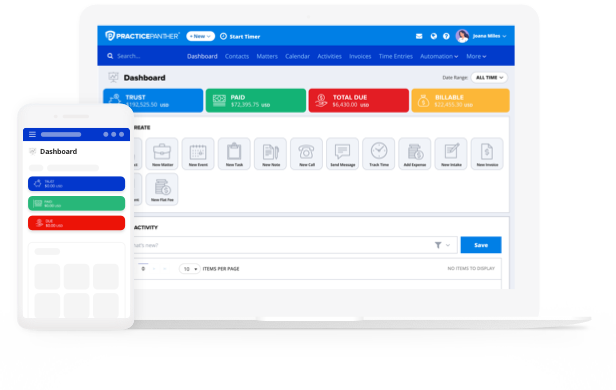
PracticePanther’s reporting and dashboard capabilities allow firms to see case progress, workload distribution, and financial performance at a glance. Instead of relying on anecdotal updates, leadership operates with data.
5. Billing Delays Caused by Disconnected Case Data
The Bottleneck
Billing often becomes an afterthought, especially when case data and time tracking are disconnected, and teams can’t see what’s coming down the pipeline fast enough. When billing is separated from overall case management, it becomes a separate administrative burden rather than a natural extension of daily work.
Some of the most common billing challenges include:
- Inaccurate time logs
- Time entries are lacking detail
- Billing review slowdowns due to cross-checking documents
- Invoices sit unapproved
The Cost
- Revenue leakage
- Slow cash flow
- Write-downs and write-offs
- Frustrated clients
Studies show lawyers often capture only 60–70% of their actual billable time with manual billing and time tracking systems. This means 30–40% of work performed never gets billed if it’s entered late or forgotten entirely. For many firms, that’s hundreds of thousands of dollars in lost revenue each year.
The Solution
Billing should be embedded directly within the matter. When billing becomes part of the workflow—not an extra step—revenue naturally improves.
Best practices include:
- Real-time time tracking tied to tasks
- Automated invoice generation
- Standardized billing workflows
- Online payment options
PracticePanther integrates time tracking, expense capture, invoicing, and payment processing within each matter. Attorneys can log time directly from tasks or calendar events, ensuring nothing gets lost.
6. Lack of Standardization Across Practice Areas
The Bottleneck
As firms expand into new practice areas or add attorneys, processes often evolve independently.
One attorney tracks deadlines one way. Another structures documents differently. A third manages communication through personal email. This inconsistency creates friction across the firm.
Without standardized templates, workflows, and reporting structures:
- Training new staff becomes difficult
- Quality varies between cases
- Institutional knowledge stays locked in individuals
The Cost
- Inconsistent client experiences
- Slower onboarding
- Higher risk exposure
- Inefficient cross-team collaboration
A firm that operates like a collection of solo practitioners struggles to scale effectively.
The Solution
Standardization does not mean rigidity—it means clarity. Firms should:
- Build template libraries for documents
- Create workflow templates for recurring matter types
- Standardize naming conventions
- Establish consistent reporting metrics
PracticePanther allows firms to build repeatable templates and workflows that maintain consistency while allowing customization where needed. When processes are standardized, growth becomes manageable instead of chaotic.
Bottlenecks Are Signs of a Broader Operational Issue
Each of these bottlenecks shares a common theme: lack of system alignment.
When case data, tasks, billing, and reporting operate independently, friction is inevitable. But when everything connects through structured workflows and centralized visibility, the firm operates as a coordinated system.
The goal of effective case management isn’t simply organization. It’s operational clarity. And clarity produces:
- Faster case progression
- More predictable revenue
- Reduced administrative burden
- Higher team morale
- Stronger client relationships
A Framework for Bottleneck Prevention
To proactively eliminate bottlenecks, firms should evaluate themselves across five dimensions:
- Centralization: Is all case data stored in a single, unified environment?
- Automation: Are repetitive tasks system-triggered rather than manually assigned?
- Visibility: Can leadership instantly see workload and financial performance?
- Standardization: Are workflows consistent across practice areas?
- Integration: Are billing, documents, and communication tied directly to the matter?
If any dimension scores low, friction will surface.
PracticePanther is built around these five pillars, enabling firms to manage cases from intake to payment within one connected platform.

Why Eliminating Bottlenecks Is a Competitive Advantage
Clients rarely see your internal systems. But they feel the effects of them.
When bottlenecks exist:
- Responses are delayed
- Documents take longer
- Bills arrive inconsistently
- Deadlines feel stressful
When systems are optimized:
- Communication is timely
- Processes feel seamless
- Billing is transparent
- Cases move forward predictably
Operational efficiency is no longer just an internal metric—it’s a client experience differentiator.
Your Next Steps
Every firm experiences growth pains. Bottlenecks are not signs of failure; they’re signs of transition. The difference between firms that plateau and firms that scale lies in how they respond.
By centralizing information, automating workflows, standardizing processes, and integrating billing within the case lifecycle, firms transform case management from a source of stress into a strategic advantage.
Because when your operations flow smoothly, everything else follows. And in today’s competitive legal landscape, operational clarity isn’t optional. It’s foundational.
Want to see how PracticePanther stops bottlenecks in their tracks? Schedule a custom demo or sign up for a free trial.