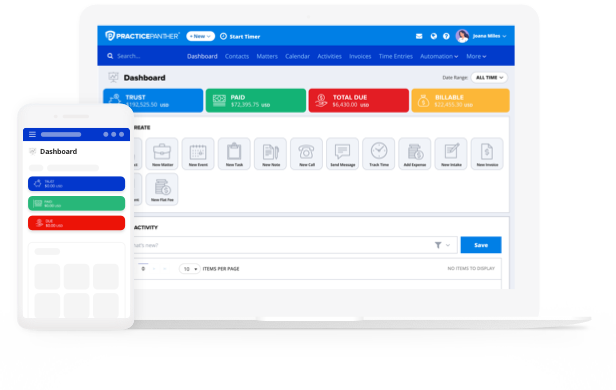
When your firm switches to comprehensive legal billing software, the impact becomes clear quickly. Billing stops feeling like a scramble, payments come in sooner, and your attorneys spend more time practicing law instead of chasing spreadsheets. The secret isn’t “better invoicing”; it’s a system where billing, case management, documents, payments, communication, and more all work together in one place.
That’s why more firms are investing in comprehensive software. In fact, 65% of firms reported budgeting for technology in 2024, and nearly 75% now use cloud-based systems for daily work.
Those numbers reflect real wins tied to specific features like built-in time tracking that automatically captures billable hours, online payments that speed up collections, customizable workflows that prevent bottlenecks, and real‑time financial reporting that helps firms understand profitability matter by matter.
When you put those pieces under the same roof, you get law practice legal billing software that supports the entire business engine of your firm. Let’s break down what that looks like in practice and how to choose a platform built to grow with you.
What Is the Best Legal Billing Software, Really?
According to a recent Statista survey, billing software is the most widely adopted legal technology across firms today. Time tracking and e-signatures follow close behind, highlighting just how critical administrative automation has become in the legal space. There are a lot of software vendors throwing the word “best” around, but what really sets the best legal billing software apart? You’ll want to look for features like:
- Expansive Billing Functionality: Look for robust billing features like built‑in timers, expense entries, billing codes (e.g. LEDES and UTBMS support), batch invoicing, and customizable invoice templates all within the platform. PracticePanther delivers this as part of our core billing module.
- ePayments (Online Payments): To speed up cash flow and reduce friction, the platform should support online payments (credit card or ACH) directly from invoices. PracticePanther’s built-in payment processor supports all of these, so clients can pay with a click, and payments land directly in your system without manual entry, reducing manual reconciliations and speeding up collections.
- Integrations: Your software should play well with the technology you already use (cloud storage, accounting systems, email/calendar apps, etc.), so you’re not juggling isolated platforms. PracticePanther offers popular integrations, helping your data flow smoothly across systems and preventing duplication. Ease of integration makes adding or retiring software much simpler as your firm grows or changes.
- Security: For any law firm, safeguarding client confidentiality is non‑negotiable. PracticePanther employs industry‑grade security (256‑bit encryption, secure cloud storage, user‑specific permissions), letting you store sensitive documents, billing info, trust account data, and more without resorting to insecure spreadsheets or ad‑hoc file sharing. You should be able to centralize your data under one secure platform in order to reduce risk. With fewer hand‑offs and fewer systems to secure individually, comes fewer potential breach points.
- Case and Matter Management: Every billable activity should be clearly connected to the work it supports. Your software should link time entries, expenses, invoices, documents, and communications directly to the correct case, client, or matter so nothing slips through the cracks. PracticePanther centralizes all matter-related information in one place, making it easy to track progress, monitor costs, and ensure accurate billing. When case details and billing data stay aligned, firms gain better visibility, reduce write-offs, and deliver more transparent updates to clients.
- Financial Reporting: Clear visibility into firm performance is essential for making informed business decisions. Your software should provide detailed, easy-to-understand reports on billed hours, collections, realization rates, and overall revenue so you can quickly assess what is working and where adjustments are needed. PracticePanther offers robust financial reporting that helps firms monitor cash flow, identify trends, and forecast more accurately, without relying on manual spreadsheets or disconnected data sources. When reporting is centralized and reliable, firm leaders can act with confidence instead of guesswork.
- Workflow Automation: Administrative tasks can quietly consume hours that should be billable or client-focused. Automating routine workflows such as payment reminders, recurring invoices, and follow-ups helps reduce manual effort and human error. PracticePanther streamlines these processes so work moves forward consistently, even when staff are busy or out of the office. By minimizing repetitive tasks, firms can improve efficiency, maintain timely billing practices, and free up time for higher-value work that directly supports growth and client service.
- Trust Accounting: Compliance matters. Your software should support trust accounting, separate ledgers, accurate tracking, disbursements, and reconciliation. PracticePanther offers native trust accounting so you don’t need a separate accounting software or spreadsheet workaround. Our built-in trust features reduce risk of compliance errors and streamline financial record‑keeping.
- eSignature: Getting signed contracts, engagement letters, and consent forms… it can be a hassle, so look for eSignature functionality to save time. PracticePanther lets you create, send, and store signed documents directly in the case file. That means no printing, faxing, or mailing, and all signatures are logged, secure, and traceable.
- Calendaring: Court dates, client appointments, filing deadlines: missing even one can be costly. The platform should offer calendar and scheduling tied to your matters. PracticePanther includes docketing, calendaring, and centralized reminders so nothing slips through the cracks. Because everything is connected (cases, documents, billing, calendar), deadlines, tasks, and billing stay aligned.
- Best‑in‑Class Support: New software only works if your team can adopt it. You want a provider that offers onboarding, responsive support, and guidance. PracticePanther backs its platform with support that helps firms of all sizes transition smoothly.

The Best Legal Billing Software Features Based on Firm Size
Putting all these pieces together is what separates the “best” billing software from the actual cream of the crop for competitive law firms. Another factor to think through is what features matter most, depending on the size of your firm:
- If you’re a solo practitioner: Prioritize time tracking and billing, online payments, and simplicity to avoid admin overhead.
- If you’re a small firm: Focus on building scalable processes as document storage, automated invoicing, workflows, and reporting become more valuable as you handle more cases.
- If you’re a mid‑size or large firm: You’ll need robust infrastructure, including integrations, automation, reporting, compliance, and admin oversight, to keep things running smoothly as complexity grows.
As you can see, the “best” feature set depends on your firm’s size, caseload, and growth plans. The goal is to avoid patchwork tech stacks, and instead adopt a single, scalable platform that grows with you.
Even the top legal billing management software can’t help you if your workflows are lackluster. You’re probably losing quite a few billable hours without even knowing it. If you’re ready to run your practice like a business, not a series of reactions, check out our Workflow Guide for Lawyers.
How Many Types of Billing Software Are There?
Not all billing software is built with law firms in mind. Some might seem fine at first glance, but when you start dealing with real client work and compliance requirements, the cracks show fast. If you’re wondering which type of billing solution makes the most sense for your firm, here’s a quick breakdown of what’s out there and how they stack up.
Spreadsheet-Based or Manual Solutions: Everyone’s familiar with Excel and Google Sheets. These are DIY billing methods where you input everything by hand, from hours worked to payment status. While this might work for a solo attorney with just a handful of clients, the risks add up quickly from missed entries, miscalculations, to time-consuming updates. This category includes what some might call simple legal billing software, but in practice, it’s rarely built for the unique needs of a law firm. Manual systems are also a nightmare when it comes to audits, trust accounting, and compliance.
Standalone Billing and Invoicing Software: This type of software automates more than spreadsheets and typically offers invoicing, time tracking, and some reporting features. But they’re often generic, not designed specifically for law firms, and they don’t integrate with case management, client communication, or trust accounting tech. They may get the job done short-term, but as your firm grows or your needs become more complex, these systems quickly hit a wall. You’ll likely find yourself patching together multiple solutions and paying more in both cost and time.
All-in-One Law Practice Management Platforms: Here’s where things get powerful. Software like PracticePanther combines billing, invoicing, payments, case management, CRM, calendaring, document handling, trust accounting, and more all under one roof. This kind of ecosystem gives your firm full visibility into your operations, supporting seamless collaboration across departments. Most importantly, it connects every billing touchpoint to the rest of your practice, so nothing falls through the cracks.
For firms looking to streamline operations and make data-driven decisions without juggling five different platforms, an all-in-one approach is the clear winner.

PracticePanther: Your Highly Recommended Legal Billing Software
Our favorite things to share are our customers transformational stories. KKOS Lawyers, a multi‑office tax and estate law firm, was struggling under outdated billing and case‑management systems. Their old workflow involved printing, mailing invoices and documents, managing on‑prem servers, and handling accounts receivable that routinely lagged, with up to 60% of their AR being more than 60 days past due.
After switching to PracticePanther, they moved everything into the cloud. They adopted automated invoicing, online payments via the built-in payment processor (PantherPayments), and a secure client portal that supports unlimited clients. That shift drastically improved efficiency: tasks that once consumed a full day per attorney now take only a few hours. More importantly, their outstanding accounts receivable dropped from 60% past‑due to around 16%, effectively eliminating the previous backlog.
Because invoicing, billing, payments, and case data are unified in one system, KKOS Lawyers avoided hiring more billing staff despite firm growth. The result was lower overhead, streamlined operations, and faster, more reliable cash flow while maintaining strong security and client communication channels.
If you’re ready to experience this kind of transformation, sign up for a free trial of PracticePanther today or click the button below to connect with our team!