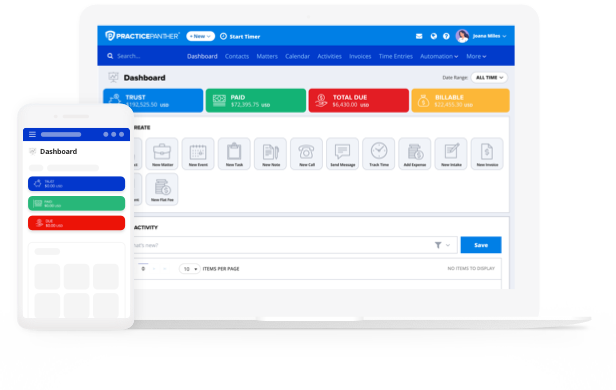
For many attorneys, financial management consumes a disproportionate amount of time and mental energy, often with limited support from legal-specific workflows in existing generic software options.
But the right legal accounting software changes all of that. Legal-specific platforms are designed to reduce compliance risk, automate reconciliation, streamline billing, and keep your books airtight—without forcing you to become a part-time accountant. Law firm accounting software also ties accounting directly to matters, ensuring your books stay accurate and audit-ready.
This guide covers everything you need to know: the core benefits of accounting platforms for law firms, the must-have features of top trust accounting software for lawyers, how to evaluate your options, and how legal-specific systems like PracticePanther’s PantherAccounting Plus unify cases, billing, and finances within one secure space.
Managing client trust accounts requires constant oversight and seamless reporting in order to prevent mistakes and ensure compliance–a pretty tall order for any law firm. Investing in a legal-specific platform takes the stress out of accounting and ensures all financial activity is connected to your casework, providing a real-time look into firm finances and client trusts.
Here’s what firms gain when they make the switch to PracticePanther’s lawyer accounting software:
- Compliance is built into firm workflows. Legal-specific platforms include safeguards that prevent commingling of funds, prevent overdrafts before they occur, and block the early recognition of unearned revenue.
- Reduced manual work and billing errors. Automation handles repetitive, error-prone tasks like matching transactions, generating reconciliation reports, and posting billable activity to the general ledger.
- Real-time visibility into firm performance. From operating cash flow to matter-level profitability, legal-specific accounting gives firm owners the financial clarity they need to make smart business decisions.
- Custom financial tracking. Every dollar is automatically tied to the right client and case—no manual cross-referencing required.
The Problem With Traditional Accounting Systems
Generic business accounting software—even QuickBooks for law firms—often struggles to meet industry-specific requirements such as compliance, matter-level financials, and reporting needs.
These platforms weren’t built to meet the unique and complex demands of a legal practice, especially not trust accounting.
When it comes to client trusts, law firms operate under a different set of rules: IOLTA requirements, ABA guidelines, and state bar regulations that dictate exactly how funds must be managed, tracked, and reported.
It’s also worth addressing the appeal of free accounting software for lawyers. Several free or low-cost options exist, and they can be tempting—especially for solo attorneys or newly launched firms watching overhead carefully. But in practice, these platforms lack the compliance guardrails and legal-specific reporting that law firms require. What looks like a cost-saving choice often becomes a liability. After all, a single trust accounting error can cost far more than any software subscription.
When firms try to make a generic platform work in a legal context, they’re left filling the compliance gaps themselves. That’s where mistakes happen. And in legal accounting, mistakes can lead to disciplinary action, or worse, disbarment.
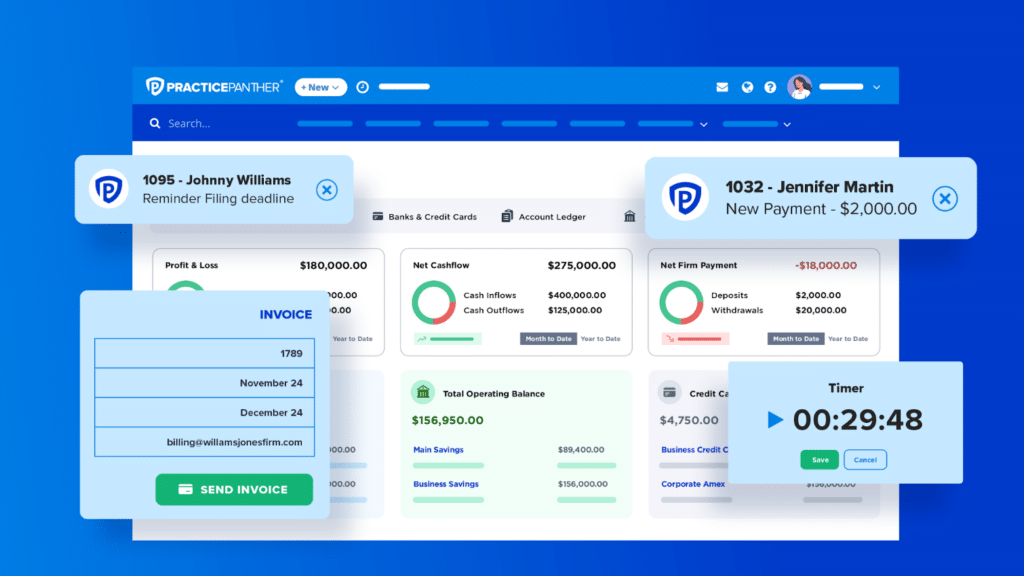
Must-Have Features of Law Firm Accounting Software
Not all accounting platforms are created equal, and when it comes to accounting for law firms, the stakes are too high to settle for a “good enough” solution. Here are the features that matter most, and how PantherAccounting Plus delivers on each.
Automated Reconciliation With Trust Accounting Compliance
Trust accounting is the highest-risk aspect of law firm finances. Client funds must remain carefully separated, accurately tracked, and fully reconcilable at all times. Month-end reconciliation is also one of the most time-consuming accounting tasks in a law firm, where even minor errors can create compliance issues.
PantherAccounting Plus actively prevents trust accounting mistakes while simplifying reconciliation workflows. This includes:
- Automated trust compliance guardrails that help prevent commingling, overdrafts, and premature revenue recognition.
- Low-balance alerts and automatic retainer replenishment incoice triggers, ensuring trust accounts stay funded without manual monitoring.
- A guided three-way reconciliation wizard that walks firms through end-of-month reconciliation in minutes. The wizard lets you match transactions and trust accounts to your client ledger and balances.
- Instant generation of custom, audit-ready reports, using PracticePanther’s guided three-way reconciliation workflows to support IOLTA, ABA, and state bar compliance requirements.
Custom Law Firm Chart of Accounts
If your firm’s financial transactions are miscoded, a snowball effect occurs:
- Case profitability is muddied
- Practice area margins become distorted
- Opportunities to recover are missed
To avoid any confusion or errors, PracticePanther’s legal firm accounting software allows users to create custom classifications for general ledger accounts. This includes expenses, assets, liabilities, income, and equity accounts. Additionally, PracticePanther connects all financial activity to your firm’s general ledger, giving you a real-time snapshot of your client trusts and matters.
As a fully customizable feature, our legal-specific chart of accounts offers flexible organization across all categories, payments, expense types, and items.
Time and Billing Automation
Billing and accounting should be two sides of the same coin. When they’re not connected, errors compound: time entries get missed, expenses don’t hit the right matter, and invoices don’t reflect what’s actually in the books.
With PantherAccounting Plus, every transaction flows automatically into matter-level financials and the general ledger. Our comprehensive general ledger feature captures all transaction history in real time across liabilities, revenue, equity, and expenses. There’s no manual posting, no double entry, just clean, accurate books.
Native Payments
Payment processing that runs through a separate system creates reconciliation headaches. When a client pays an invoice or funds a retainer, that transaction needs to flow immediately and accurately into your accounting records.
PracticePanther’s native payment workflows sync deposits, payments, and trust transactions automatically with your accounting data. This eliminates reconciliation errors associated with third-party add-ons and accelerates your firm’s cash flow.
Additionally, PracticePanther’s online payment processing capabilities enable firms to apply payments to trust and operating accounts, accept multiple payment methods, generate custom payment reports, and more.
This solution is completely audit-proof and compliant, adhering to IOLTA, ABA, and state bar guidelines with secure billing that allows you to deposit retainer payments directly into your trust accounts.
Built-In Matter Management
A disconnected accounting system can be a liability. If your financial data lives in one platform and your case information lives in another, you’re constantly at risk of transactions being miscoded, misapplied, or missed entirely.
Because PantherAccounting Plus is built directly into PracticePanther’s legal practice management software, every financial transaction is automatically linked to the appropriate matter. There are no external integrations to maintain, no duplicate data entry, and no risk of financial and case data falling out of sync.
Comprehensive Financial Reporting
Firm owners need more than compliant books—they need insight. Understanding where revenue is coming from, where overhead is climbing, and which matters are most profitable requires robust, flexible reporting.
PantherAccounting Plus (alongside PracticePanther’s legal billing software) delivers:
- Pre-built reports including Profit & Loss, Balance Sheet, Cash Flow Statement, and Trial Balance
- Customizable operating reports filterable by date range, contact, matter, account, or payee
- Tax-ready books year-round, so year-end isn’t a scramble
- Export and sharing capabilities for working with external accountants or stakeholders
Evaluating Legal Accounting Software for Lawyers
When you’re comparing options, the goal is to find a platform that was designed around legal workflows from the ground up, not a general business solution with a few legal features bolted on. Here’s what to look for:
- Look for a unified platform. The more systems you’re working across, the more opportunities for error. The ideal solution manages cases, billing, payments, trust accounting, and operating accounting in one place, with real-time data flow between all of them.
- Start with trust accounting safeguards. This is the single highest compliance risk area for law firms. If a platform doesn’t have built-in protections against commingling, overdrafts, and early revenue recognition, move on.
- Make sure every case transaction ties back to a matter. Matter-level transparency is non-negotiable. You should be able to see exactly which client and case is associated with every dollar in and out of your accounts.
- Evaluate the reconciliation workflow. Ask whether the platform guides you through three-way reconciliation or leaves you to manage it manually.
- Assess reporting depth. Can you generate the reports your accountant needs? Can you filter by matter, date, or client? Are your books tax-ready throughout the year, or only after a major year-end cleanup?
- Consider scalability. A platform that works well for a two-attorney firm should also scale comfortably as you grow. Look for solutions that can handle increasing transaction volume, more complex trust management, and expanded reporting needs without requiring a platform change.
When evaluating platforms that market themselves as alternatives to QuickBooks for lawyers, pay close attention to where the compliance responsibility lies. If you’re required to configure workarounds for IOLTA compliance or trust accounting safeguards, that’s a red flag. Trust accounting software handles compliance by design.
Choosing the Best Accounting Software for Lawyers
The right accounting software doesn’t just keep your books clean; it protects your clients, your license, and your firm’s financial health. The criteria covered in this guide aren’t nice-to-haves. They’re the baseline for any platform serious about serving law firms.
PantherAccounting Plus was built specifically to meet that standard. It offers automated trust compliance, a guided reconciliation workflow, native billing and payments, comprehensive financial reporting, and a complete, real-time accounting assistant built directly into PracticePanther’s practice management system. The result is a single source of truth for every client, matter, and financial transaction your firm handles.
Whether you’re re-evaluating your current setup, growing beyond a patchwork of disconnected systems, or simply looking for a more confident approach to compliance, it’s worth exploring what an all-in-one solution can do for your practice.
Book a demo to see how PracticePanther works—or dive deeper into trust and firm accounting best practices to continue building your knowledge.